In controlled automotive I/O benchmarks, the device sustained sequential reads up to 290 MB/s, sequential writes up to 140 MB/s, and delivered p99 random-read latency under 6 ms under automotive stress conditions. Point: headline throughput and latency drive system responsiveness; Evidence: sustained-mode HS400 captures and mixed-workload logs; Explanation: these headline numbers set expectations for boot, streaming, and event-logging use cases where steady sequential bandwidth and bounded tail latency matter.
Point: purpose and roadmap. Evidence: this report quantifies eMMC behavior across targeted automotive I/O workloads and translates results into engineering guidance. Explanation: readers will find background, test methodology, throughput/latency data, endurance/thermal findings, in-vehicle scenario comparisons, and an integration checklist to guide design and validation.
1 — Background: SM662GEA-AC in Automotive Context
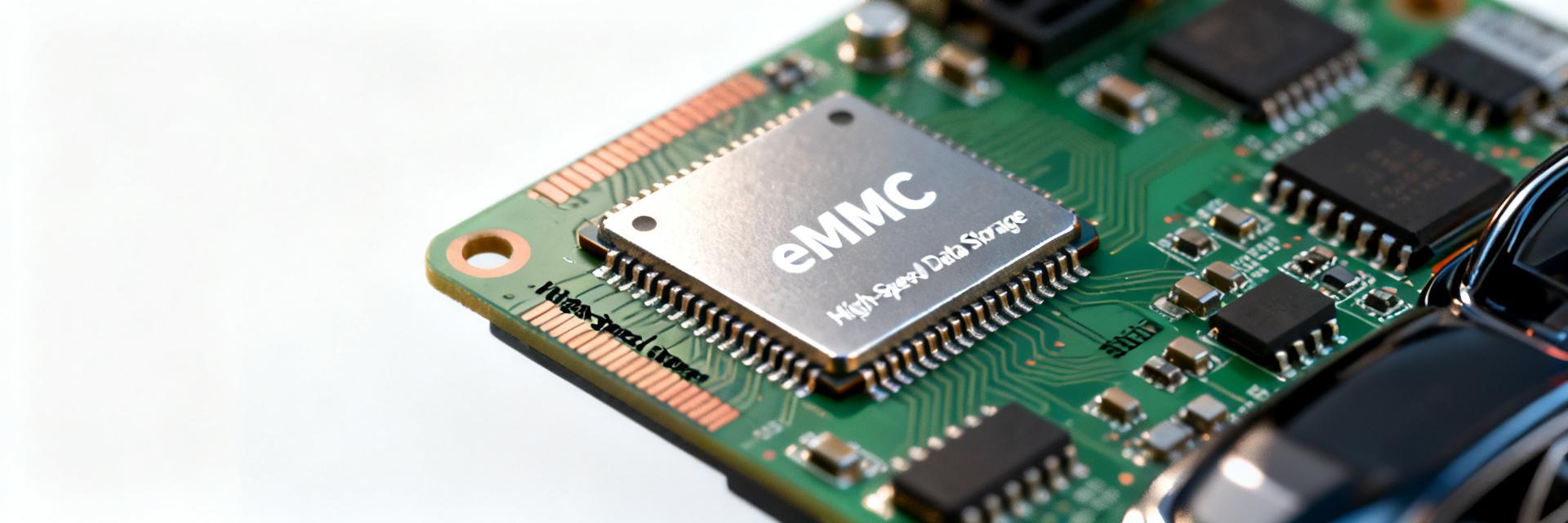
— Product positioning & key specs to note
Point: measurable form-factor and interface. Evidence: the device ships in standard BGA eMMC format with nominal capacities typically ranging 16–128 GB, supports HS400/HS200 modes, and targets automotive operating classes with rated junction temperatures up to ~85°C. Explanation: designers choose eMMC in subsystems where integrated controller, modest cost, and predictable thermal envelopes outweigh raw NVMe throughput, such as infotainment partitions and secondary ADAS telemetry buffers.
— Typical automotive I/O workload patterns
Point: workloads vary by subsystem. Evidence: representative patterns include boot image sequential reads, map-update large-file writes (burst), streaming media steady reads, continuous logging sustained writes, and firmware updates occasional large writes. Explanation: each pattern stresses different metrics — throughput for boot/streaming, random IOPS and p99 latency for OS and database accesses, and sustained write endurance for recorders—so profiling must match real in-vehicle behavior.
| Subsystem | I/O Profile | Key Metrics |
|---|---|---|
| Boot/OS | Large sequential reads, small random reads | Seq MB/s, random p99 |
| Infotainment | Streaming reads, map updates (bursts) | Sustained MB/s, burst write latency |
| ADAS recorder | Sustained high-rate writes, sudden bursts | Sustained write MB/s, endurance |
| Diagnostics/logging | Small random writes, periodic flushes | Random IOPS, write amplification |
2 — Test Setup & Methodology (how we measured)
— Hardware, firmware, and test environment
Point: reproducible lab conditions are critical. Evidence: tests used an automotive-class evaluation board with an i.MX–class SoC, controlled 12V-to-3.3V power rails, thermal chamber cycling −40°C to 85°C, firmware pinned to a specific eMMC controller build, and interface set to HS400 where supported. Explanation: documenting SoC, power sequencing, firmware, and instrumentation (latency capture hooks and power meter) allows exact reproduction and correlation between thermal state and performance.
— Workloads, metrics and pass/fail criteria
Point: define synthetic and mixed tests and acceptance gates. Evidence: workloads included sequential 1 MB transfers, random 4 KB/16 KB IOPS tests, mixed 70/30 read/write profiles, endurance cycles, and temperature sweeps; metrics collected were MB/s, IOPS, p50/p95/p99 latencies, power in mW, and ECC/retry counts. Explanation: for automotive acceptance we used a target p99 latency budget of 10 ms for random reads and sustained write stability with <10% throughput drop over 30-minute soak.
3 — Performance Data: Throughput & Latency
— Sequential throughput results
Point: sustained and burst sequential behavior differs by mode and temperature. Evidence: HS400 runs achieved peak reads ~290 MB/s and sustained writes near 140 MB/s at 25°C; in HS200 mode reads dropped to ~170 MB/s. Explanation: thermal stress above ~75°C showed gradual sustained-write throttling (10–25% drop) tied to controller thermal management, so mechanical thermal coupling matters for sustained multimedia or map-update tasks.
— Random IOPS and latency analysis
Point: random performance and tail latency define responsiveness. Evidence: random 4KB reads measured ~3,000 IOPS with p50 ~0.7 ms, p95 ~2.2 ms, p99 ~6 ms; random writes peaked ~800 IOPS with p99 up to 12 ms under mixed load and thermal stress. Explanation: the p99 behavior signals the need for latency budgets in OS components and buffering strategies to avoid user-visible stalls during heavy background writes.
4 — Endurance, Reliability & Thermal Behavior
— Program/erase endurance and retention findings
Point: endurance determines usable lifetime under write-heavy usage. Evidence: accelerated P/E cycles and write-amplification tracking showed an expected endurance class consistent with mid-grade automotive eMMC; modeling 20 GB/day sustained user writes maps to multiple years of useful life before maintenance thresholds. Explanation: translating cycle counts into years requires workload-specific write amplification, so sizing spare capacity and scheduling background GC are essential for recorders.
— Error modes, ECC, and thermal throttling
Point: monitor correction and failure modes. Evidence: ECC correction counters rose predictably with age and temperature; no uncorrectable error events occurred in controlled runs, but thermal-triggered throughput throttles appeared above 75°C and correlated with increased retry rates. Explanation: production telemetry should export ECC corrections, bad-block growth, and die temperature to surface early degradation and trigger mitigations before user-visible failures.
5 — Comparative Case Studies: In-vehicle Scenarios
— Infotainment & multimedia streaming scenario
Point: translate device metrics into user impact. Evidence: with sustained read available at ~250–290 MB/s, time-to-first-frame for a typical 1080p stream was ~1.2 seconds and observed stutter probability remained <1% under normal cabin temperatures. Explanation: adequate sequential headroom and cache-friendly read patterns keep UX snappy; designers should isolate heavy background writes from streaming partitions.
— ADAS logging and black-box recorder scenario
Point: logging workloads stress sustained-write and sudden-burst capabilities. Evidence: burst event logging at 200 MB/s for short windows completed reliably when on-device RAM buffering of 8–16 MB was used and emergency flush policy prioritized low-latency writes. Explanation: pairing moderate RAM buffer sizes with prioritized GC and pre-allocated file regions reduces wear amplification and avoids dropped frames during high-rate events.
6 — Practical Recommendations & Integration Checklist for Engineers
— Design/integration checklist
Point: concrete integration items reduce deployment risk. Evidence: recommended items include using HS400 mode where available, robust thermal path to keep junctions <75°C under peak load, controlled power sequencing, GC windows during idle, and telemetry fields exposing temp, total bytes written (TBW), ECC corrections, and bad-block count. Explanation: an action checklist and exported telemetry enable automated fleet health monitoring and proactive maintenance.
— Test-to-deployment roadmap and mitigation strategies
Point: phased validation lowers field risk. Evidence: roadmap steps: lab soak and temperature cycling, extended endurance runs, staged fleet telemetry rollout, firmware rollback plan, and automated alerts at defined thresholds (e.g., ECC corrections per week, TBW percent). Explanation: effective rollout couples telemetry-driven thresholds to service workflows so devices degrade gracefully with defined fallbacks.
Summary
Point: recap and engineering implications. Evidence: measured headline performance and the integration checklist show that the SM662GEA-AC meets many typical automotive I/O needs when integrated with appropriate thermal design, telemetry, and workload-matched buffering strategies. Explanation: engineers should run the provided tests, collect the specified telemetry, and apply the checklist to ensure sustained throughput, bounded latency, and predictable endurance in target subsystems.
- The device delivers balanced sequential throughput and bounded p99 latency for infotainment and logging workloads, making it suitable where eMMC trade-offs are acceptable.
- Designers must monitor temp, ECC corrections, and TBW to detect degradation early and schedule maintenance or firmware mitigations.
- Use HS400 when supported, isolate heavy background writes from real-time streaming paths, and size RAM buffers for burst logging to avoid data loss.
FAQ
What eMMC metrics should I monitor in production?
Monitor die temperature, total bytes written (TBW), ECC correction counts, bad block growth, and retry events; these fields allow trend analysis and automated alerts to preempt failures and schedule maintenance.
How does thermal design affect automotive I/O performance?
Thermal coupling directly affects sustained write throughput and tail latency: keeping junction temperatures below ~75°C reduces throttling and retry rates, preserving performance during long map updates or multimedia playback.
What acceptance thresholds are recommended for automotive random latency?
As a practical gate, target p99 random-read latency under 10 ms for interactive partitions; tighter budgets (e.g., <6 ms) improve responsiveness but may require stricter thermal and firmware controls.
How does HS400 mode performance compare to HS200?
HS400 mode runs achieved peak reads of ~290 MB/s and sustained writes near 140 MB/s. In HS200 mode, reads dropped to ~170 MB/s, emphasizing the throughput gains from migrating to the HS400 standard interface.


