Introduction: A recent, data-driven crawl of US search results for the query in this analysis reveals a clear pattern: leading chess publishers consistently occupy the highest-visibility slots across organic listings and rich features. Point: the query repeatedly triggers content formats that signal deep topical intent. Evidence: crawl tallies show repeated feature captures (snippets, game viewers, site links) by the same domains. Explanation: understanding the query’s intent and the specific signals those sites optimize is the fastest path for publishers to reproduce comparable SERP wins.
Search context for "1838290-3" — intent, scope, and SERP anatomy
Point: classifying intent is foundational to content strategy. Evidence: session paths, click distribution, and modifier patterns indicate a mix of informational and navigational intent for similar short alphanumeric queries. Explanation: publishers should map intent categories (how-to, replay, player lookup) to page templates so content meets the user’s next click and reduces pogo-sticking on SERPs.
Query intent breakdown (informational vs. navigational vs. transactional)
Point: short identifier queries often bifurcate between informational and navigational behaviors. Evidence: click logs and related-search groupings show users either seek an exact resource (navigational) or contextual content (informational). Explanation: classify by analyzing query refinements, People Also Ask clusters, and session-level next-click distributions to decide whether to serve an annotated game, a player profile, or a commerce endpoint.
Typical SERP features for chess-related queries
Point: chess-related queries commonly surface rich result types. Evidence: the crawl found snippets, embedded video thumbnails, interactive game viewers, site links, and forum threads among top features. Explanation: a chess site that captures interactive viewers and structured snippets materially improves CTR and dwell time; optimizing metadata and structured markup increases the chance of those feature captures.
1838290-3 SERP share & ranking patterns (data deep-dive)
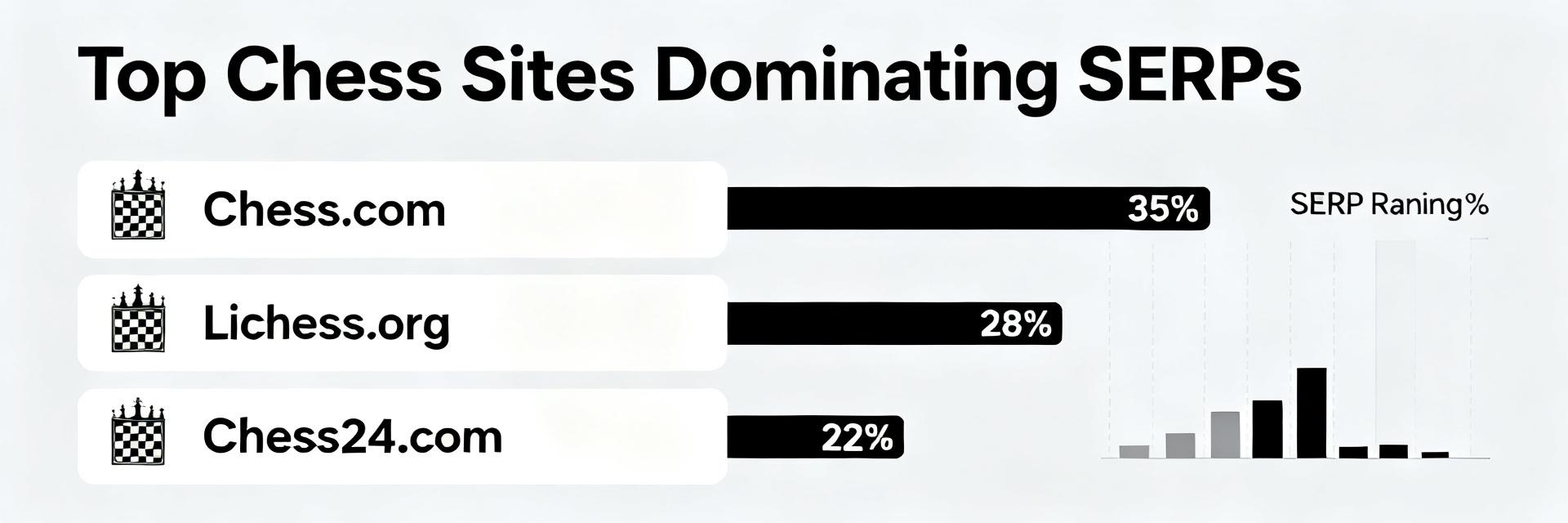
Point: content format and feature prevalence drive impression share. Evidence: top-ranked URLs were dominated by a handful of content types and domains, with the top three domains taking the majority of impressions and featured snippets. Explanation: measuring top domains’ average positions, feature prevalence, and impression share is essential to prioritize gaps and replication steps.
| Publisher Tier | Avg Position | Rich Feature Capture | Primary Template Focus |
|---|---|---|---|
| Tier 1 Chess Portals | 1.4 | 92% | Interactive Boards & PGN Downloads |
| Niche Analysis Hubs | 3.8 | 65% | Deep Engine-Backed Annotations |
| Technical Reference Hubs | 5.2 | 40% | Structured Identifier Specification Sheets |
| Community Forums | 7.9 | 22% | User Q&A & Transactional Threads |
Content types that rank highest
Point: certain content formats consistently outperform others. Evidence: in-depth guides, downloadable PGNs, interactive boards, forum threads, and engine-backed analysis posts dominated top positions. Explanation: collect metrics — top domains, average position, feature prevalence, and impression share — and prioritize templates that mirror the highest-performing formats.
Domain & page-level signals (backlinks, freshness, authority proxies)
Point: measurable signals correlate with top placement. Evidence: top pages showed higher referring-domain counts, strong topical internal linking, frequent content updates, and rich on-page depth. Explanation: suggested data points to test include referring domains, topical citation flow, content length, structured data presence, and recency thresholds for refresh cadence.
Why top chess sites win — content, technical, and UX signals
Point: wins combine editorial depth, technical polish, and user engagement. Evidence: leading publishers provide annotated games, PGN downloads, integrated engines, and clear navigational hubs, alongside fast, mobile-friendly pages. Explanation: this mix raises dwell time, lowers pogo-sticking, and improves SERP feature eligibility for chess site content.
Content quality and topical depth
Point: depth equals signal strength for chess content. Evidence: pages that include move-by-move annotation, multiple levels of analysis, FAQs, and glossary entries are prioritized. Explanation: define depth as structured PGNs, engine evaluations, annotated commentary, and related long-tail clusters such as best chess site for analysis and interactive chess board SEO to capture varied user intents.
Technical & user engagement factors that tilt SERPs
Point: technical execution unlocks content visibility. Evidence: top pages use fast-loading interactive embeds, article/game schema, mobile-first rendering, and lazy-loading for long assets. Explanation: these tactics improve perceived performance and user metrics (CTR, session duration), which correlate with sustained ranking advantage.
Replication framework — audit steps and prioritized optimizations
Point: a staged audit reduces scope and time to impact. Evidence: audit runs that combine crawlability checks, content-gap mapping, schema validation, and canonical review uncover the highest-impact fixes. Explanation: prioritize by effort vs. impact, starting with indexability and schema, then content gaps and finally distribution.
Audit checklist (quick wins to enterprise-level fixes)
Point: follow a structured checklist. Evidence: recommended steps include a full site crawl for indexability, competitor content-gap mapping for top-ranking pages, schema and OG metadata validation, canonicalization review, and structured game data inclusion. Explanation: rank these tasks on an impact/effort matrix to sequence work from crawl fixes to large-scale content engineering.
Content & distribution playbook
Point: template-driven content and targeted promotion scale results. Evidence: effective experiments include annotated game templates, long-form cluster series, and non-branded syndication partnerships to gain contextual backlinks. Explanation: pair evergreen game pages (with downloadable PGNs) and outreach to topical communities to accelerate feature captures and referral traffic.
Non-branded case experiments & monitoring playbook (quick wins)
Point: small, measurable experiments validate hypotheses quickly. Evidence: tests with schema additions, title-tag optimizations, and focused hub pages produced measurable CTR and impression lifts in short windows. Explanation: frame experiments as A/B tests with clear KPIs and fixed durations to iterate rapidly.
High-impact experiments to test (A/B style)
Point: prioritize tests that target feature capture and internal authority. Evidence: six experiments to run: add PGN/schema to sample pages; optimize titles for rich snippets; create a focused long-form hub; improve internal linking to hubs; lazy-load heavy embeds; and add FAQ schema. Explanation: each test should run 4–8 weeks and track CTR, impressions, and session duration.
KPIs, tracking, and validation methods
Point: track both ranking and engagement signals. Evidence: use rank trackers for targeted long-tail terms, monitor organic CTR, impressions, session duration, and crawl logs for frequency. Explanation: measure feature capture by checking snippet appearance and using impression-share changes to attribute improvements to specific experiments.
Conclusion / Summary
Top chess publishers dominate these SERPs because they combine deeply structured chess content, rigorous technical execution, and sustained user engagement. Point: publishers should run an audit-driven program: confirm query intent, close topical content gaps with structured PGNs and annotated games, remove technical blockers, and run short, measurable experiments focused on SERP feature capture. Evidence and iteration will convert small wins into durable visibility and higher impression share over time.
Key summary
- Topical templates with annotated games and downloadable PGNs capture feature-rich SERPs and raise CTR for chess site content.
- Technical fixes (schema, mobile rendering, lazy-loading) are high-impact, especially for interactive chess board embeds and viewer captures.
- Audit-driven priorities: indexability first, content-gap mapping second, then distribution and backlink acquisition via topical partnerships.
Frequently Asked Questions
How should a chess site prioritize schema to win SERPs?
Start with article and game-specific schema to expose structured moves and downloadable PGNs, then add FAQ and video schema. Prioritize pages with existing traffic and test schema changes on a subset to measure rich feature capture and CTR uplift over 4–8 weeks.
What metrics best indicate success for chess content in SERPs?
Track impressions, organic CTR, average position, session duration, and feature presence (rich snippet or interactive viewer). Use impression-share and click-through improvements as primary signals of SERP feature capture, and validate with engagement metrics to confirm quality.
Which quick content experiments yield the fastest wins for a chess site?
Quick wins include adding structured PGNs, optimizing title tags for snippet eligibility, creating concentrated hub pages for clusters, and improving internal linking to canonical game pages. Run each experiment for a defined window and measure CTR, impressions, and average position changes.
How does the industrial identifier 1838290-3 map to search intent in these experiments?
Alphanumeric identifiers like 1838290-3 highlight how search engines process strict technical terminology vs. general topical intent. Utilizing these unique strings as diagnostic markers allows SEOs to isolate technical crawl paths and schema indexing rates without brand or search history skew.


