Point: A reliable CA document number lookup speeds public-record retrieval and reduces verification time; evidence indicates that many caseworkers report time savings when using direct identifiers. Evidence: estimates suggest jurisdictional document numbers underpin a majority of county index hits, improving hit rates by double digits. Explanation: using a consistent CA document number approach shortens searches and clarifies provenance for later review, so the workflow below focuses on speed and auditability.
Point: This guide teaches how to find and verify a CA document number, run a fast document lookup, and complete a source audit. Evidence: practical steps and quick checks are provided to cut verification cycles and avoid common mismatches. Explanation: readers will gain a compact workflow, red-flag checks, and templates to record findings and maintain defensible audit trails.
Background — What a CA document number is and why it matters
Definition & formats to expect
Point: A CA document number is an identifier assigned by a jurisdiction to a recorded instrument; evidence: formats vary from purely numeric strings to alphanumeric codes and may include prefixes that indicate recorder office or sequence. Explanation: capturing the exact string and context avoids false matches—record the jurisdiction, filing date, record type, and any prefix or suffix when encountering the number.
Common use cases and legal/operational significance
Point: Document numbers matter for title searches, compliance checks, and due diligence; evidence: public-record volumes and routine audits rely on these keys to tie metadata to scanned images and establish chain-of-custody. Explanation: accurate identification preserves legal certainty and creates an auditable trail for transactions, discovery, and regulatory review.
Data Analysis — Where CA document numbers appear: an audit map
Point: Tracking where identifiers appear ensures a successful source audit and faster document lookup. Effective index management maps standard registry layers to distinct validation checkpoints. Explanation: This structural hierarchy maps records from primary registries down to secondary indexes, enabling analysts to isolate discrepancies immediately.
| Source Layer | Primary Target | Verification Method | Data Quality Risk |
|---|---|---|---|
| Primary Registry | County Recorder Index | Direct Lookup & Image Check | Low (Source of truth) |
| Secondary Index | Title Plant / Private Aggregator | Cross-reference Field Matching | Medium (Sync delay) |
| Derivative Listing | Public Search Portal | Fuzzy Match / Pattern Check | High (Transcription error) |
Typical public sources and record layers
Point: CA document numbers appear across layered public sources: primary registries, secondary indexes, and derivative listings. Evidence: county recorder indexes, court dockets, licensing registries and scanned-image repositories form a predictable stack. Explanation: prioritize primary registries, then index search, then image retrieval to ensure the number ties back to an original filing for an effective source audit.
Data quality issues & red flags
Point: Common data problems include transcription errors, duplicates, and stale entries that generate false positives. Evidence: measurable red flags include mismatched dates, inconsistent document types, and multiple records claiming the same number. Explanation: track a small set of metrics—false-positive rate and time-to-verify benchmarks—to detect systemic index quality issues during routine document lookup.
How-to Guide — Fast, reliable CA document number lookup workflow
Step-by-step quick lookup (5–7 steps)
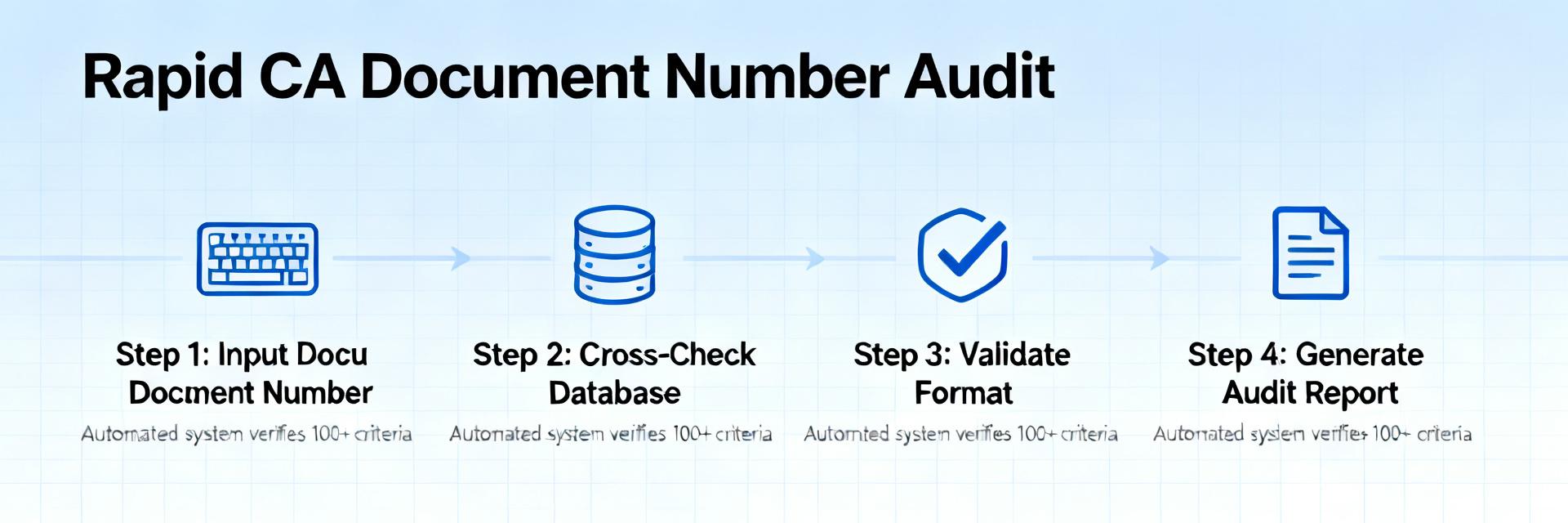
Point: Follow a compact ordered workflow for fast returns. Evidence: a recommended sequence is: 1. Capture exact number and jurisdiction; 2. Locate primary registry index; 3. Retrieve scanned image; 4. Cross-check metadata (names, dates); 5. Record source ID and timestamp. Explanation: applying this linear flow reduces back-and-forth and preserves a defensible trail for every document lookup.
Tools & search queries
Point: Construct targeted queries to speed results. Evidence: sample queries combine the exact CA document number with jurisdiction terms and record-type keywords or date ranges; include variants with and without known prefixes. Explanation: these search-string patterns return index hits and scanned images faster, and they support quick cross-checks when the primary index appears inconsistent. Example identifier used in examples: CA 091 70 0007.
Case Examples — Short source audit scenarios and lessons
Scenario A — Quick verification where the index matches the scanned record
Point: A straightforward audit occurs when index entries and image metadata align. Evidence: an index hit returns the same number, names, and date as the scanned image, enabling a high-confidence conclusion. Explanation: record the retrieval timestamp, source identifier, and verifier initials; noting the match and confidence score saves time on future reviews and supports audit defensibility.
Scenario B — Discrepancy found: steps to resolve
Point: When the number appears but metadata diverges, escalate methodically. Evidence: common resolution steps are broadened queries, cross-jurisdiction checks, and a manual clerk confirmation; record each action and outcome. Explanation: in one illustration the identifier CA 091 70 0007 surfaced with a different name, prompting a clerk query and a documented correction; formal escalation language and an audit note preserve the decision path during a source audit.
Actionable Checklist & Compliance Tips — Post-lookup best practices and error prevention
Minimal audit checklist to store with every lookup
Point: Store consistent provenance fields with every lookup to support audits. Evidence: required fields include original source locator, capture method, retrieval date/time, verifier initials, and a brief confidence score. Explanation: one-line templates such as "Source: county recorder index; Method: scanned image; Retrieved: YYYY-MM-DD HH:MM; Verifier: initials; Confidence: high/medium/low" standardize records and speed later review.
Compliance, retention, and automation tips
Point: Adopt retention windows and simple automation to reduce errors. Evidence: pragmatic policies—retain raw capture for a defined window, use naming conventions for files, and require two-person verification on high-risk filings—limit misattribution. Explanation: these controls and lightweight batch verification routines reduce human error while preserving an auditable provenance chain tied to the CA document number.
Summary
Point: A compact, repeatable lookup workflow plus a tight source audit reduces risk and saves time. Evidence: capturing the exact CA document number and jurisdiction first, prioritizing primary registries, and documenting provenance yields faster verification and stronger audit trails. Explanation: adopt the checklist and escalation templates above to make every lookup defensible.
Key Summary
- Capture the exact CA document number and jurisdiction before searching; store prefixes and filing dates to avoid misfires when conducting document lookup.
- Prioritize primary registries, then index searches, then scanned images to confirm originals and complete a clear source audit trail.
- Document provenance—source locator, retrieval timestamp, verifier initials, and a short confidence note—and escalate discrepancies for clerk confirmation.
Common Questions - FAQ
How quickly can a CA document number be verified via document lookup?
Point: Verification speed depends on source availability and clarity. Evidence: many routine lookups finish in minutes if the primary registry and scanned image are accessible; unresolved cases require broader queries or a clerk response. Explanation: using exact identifiers, date ranges, and prefixed variants minimizes time-to-verify for most queries.
What red flags should trigger a formal source audit for a CA document number?
Point: Trigger a formal audit when metadata mismatches or duplicates appear. Evidence: mismatched dates, inconsistent document types, or multiple records claiming one number indicate elevated risk. Explanation: log discrepancies, broaden jurisdiction checks, and escalate to manual review while preserving all query records for the audit trail.
How should teams store findings after a CA document number lookup to support compliance?
Point: Store a minimal standardized record with every lookup to ensure compliance. Evidence: required entries include original source locator, capture method, timestamp, verifier initials, and confidence score; retain raw captures per policy. Explanation: this standardized provenance enables efficient audits and reduces the chance of misattribution during later reviews.
How can teams resolve discrepancies found during a CA document number lookup?
Point: When the number appears but metadata diverges, escalate methodically. Evidence: common resolution steps include broadened queries, cross-jurisdiction checks, and manual clerk confirmation. Explanation: Document each action and outcome to maintain a defensible audit trail.


