Latest U.S. data indicates replacing a single 60W-equivalent incandescent with a 10W LED cuts lighting energy use by roughly 75%–85%, trimming hundreds of dollars from a typical homeowner’s electricity bill over a bulb’s usable life. This report compares LED vs incandescent on energy, lifespan, and total cost of ownership so homeowners can make practical retrofit choices.
The goal is practical: show simple math, real-world lifespan ranges, and room-by-room recommendations that enable homeowners to audit five high-use bulbs, estimate payback, and act with confidence using clear numbers rather than marketing claims.
How LED and Incandescent Bulbs Work — quick technical primer
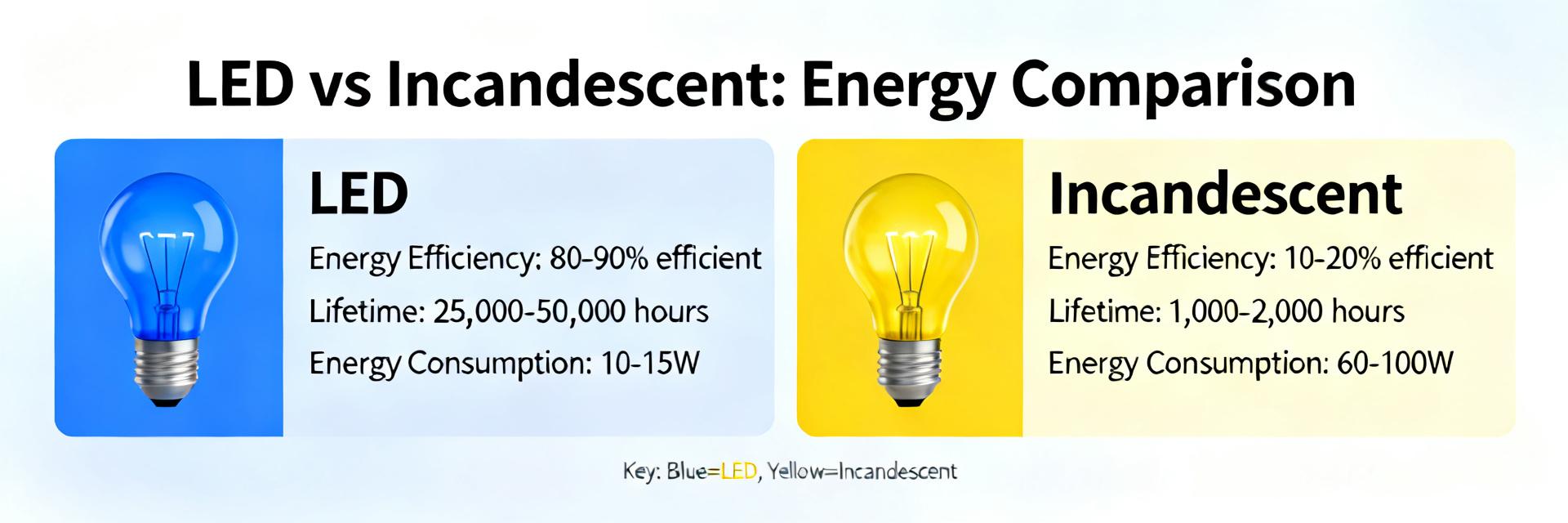
Core technology differences
Incandescents produce light by heating a tungsten filament until it glows, wasting most input as heat. LEDs produce light via a semiconductor diode that emits photons when current flows; far less is lost to heat. Below is a structural flow diagram highlighting these core physical properties.
Typical specs homeowners see (watts, lumens, color temperature)
Packaging now emphasizes lumens (light output) not watts (power). Common equivalence: a 60W incandescent ≈ 800 lumens, typically matched by a 8–12W LED. Also check CRI (aim ≥80) and CCT in Kelvin (2,700–3,000K warm, 3,500–4,100K neutral). These specs affect perceived quality and long-term energy use.
Data Analysis #1: Energy Use & Cost — side-by-side comparisons
Annual kWh and cost model for a typical home
Example math: bulb on 3 hours/day. Incandescent 60W → 0.06 kW × 3 × 365 = 65.7 kWh/year. LED 10W → 0.01 kW × 3 × 365 = 10.95 kWh/year. Using a U.S. average retail rate near $0.15/kWh, annual cost ≈ $9.86 for incandescent and ≈ $1.64 for the LED, so annual savings ≈ $8.22 per bulb.
| Type | Wattage | Annual kWh | Annual Cost (@$0.15/kWh) |
|---|---|---|---|
| 60W incandescent | 60 W | 65.7 | $9.86 |
| 10W LED | 10 W | 10.95 | $1.64 |
Total cost of ownership over product lifetime (purchase + energy + replacement)
Assume bulb prices: incandescent $1, LED $3; rated lifespans: incandescent 1,000 hours, LED 15,000 hours. Over 15,000 hours (roughly 13.7 years at 3 hours/day) incumbents require 15 bulbs ($15) plus higher energy; single LED handles the period. Cumulative savings appear in year one and grow substantially over 5–10 years.
Data Analysis #2: Lifespan, Reliability & Performance Over Time
Typical lifespans and real-world failure modes
Rated lifespans commonly: incandescent ~1,000 hours; LEDs often 15,000–25,000+ hours depending on quality. Real-world factors shorten life: excessive heat, poor ventilation, incompatible dimmers, and frequent on/off cycling. Warranty and manufacturer runtime testing indicate quality variation—higher-quality LEDs tolerate tougher conditions and deliver longer usable life.
Light quality, lumen depreciation, and performance in fixtures
CRI measures color accuracy; choose CRI ≥80 for general use, ≥90 for art or makeup areas. LEDs experience lumen depreciation over time; good thermal design and driver quality slow degradation. In recessed cans or unventilated fixtures, expect reduced LED lifespan unless the lamp is rated for enclosed fixtures.
Practical Guide: How to Choose the Right Bulb for Each Room
Matching lumens, color temperature, and CRI to room use
Room recommendations: Kitchen task zones 400–800 lumens per fixture, 2,700–3,500K, CRI ≥90 for counters; Living rooms 300–600 lumens, 2,700–3,000K, CRI ≥80; Bedrooms 200–400 lumens, 2,700K; Bathrooms brighter near mirrors, CRI ≥90. Match lumens to desired brightness rather than watt-equivalent numbers to optimize energy and comfort.
- Kitchen task: 600–800 lumens, 2,700–3,500K, CRI ≥90.
- Living room: 300–600 lumens, 2,700–3,000K, CRI ≥80.
- Bedroom: 200–400 lumens, warm 2,700K, CRI ≥80.
Calculating payback & selection checklist
Payback formula: (Incremental bulb cost) ÷ (annual energy savings). Example: $2 extra for LED ÷ $8.22/year ≈ 0.24 years (≈3 months) payback for that bulb. Checklist: lumens, watt-equivalent, CRI, CCT, warranty, dimmer compatibility, ENERGY STAR qualification, and local rebate eligibility.
Case Studies: Real Homeowner Scenarios (anonymized)
Case A — Whole-home retrofit (energy-first)
Before: 30 frequently used incandescent bulbs average 3 hours/day = annual lighting load ~1,971 kWh. After swapping to LEDs, load drops to ~328 kWh, saving ~1,643 kWh/year, roughly $246/year at $0.15/kWh. Upfront lamp cost was recovered in under two years when factoring avoided replacement purchases and energy savings.
Case B — Targeted swaps (lifespan & light-quality focus)
A homeowner replaced living-room and vanity lamps with high-CRI LEDs and kept vintage incandescent fixtures for ambience. Results: improved color rendering and far fewer replacements; marginally higher upfront cost but strong non-energy value in comfort and reduced maintenance over multiple years.
Action Checklist & Implementation Roadmap
Quick shopping checklist and what to read on labels
When shopping, verify lumens, watt-equivalent, CRI ≥80 (prefer ≥90 where color accuracy matters), CCT, dimmer compatibility, warranty length, and ENERGY STAR rating if available. Read packaging for fixture limitations (enclosed-rated) and driver type to avoid premature failures and ensure expected lifespan and performance.
- Lumens and watt-equivalent
- CRI ≥80 (≥90 for detailed tasks)
- Enclosed fixture rating and dimmer compatibility
Installation, disposal, and rebates
Swap bulbs only after power is off and fixtures cool. Incandescents can usually be disposed with household waste, but check local rules for recycling options. For incentives, check state or utility rebate portals and ENERGY STAR programs to maximize upfront savings; many rebates target LEDs and may shorten payback further.
Summary (actionable wrap-up)
In most home uses, LED vs incandescent results favor LEDs: significantly lower energy use, far longer lifespan, and lower lifetime cost while delivering comparable or better light quality when CRI and CCT are chosen deliberately. Start by replacing the five most-used incandescent bulbs and track energy and replacement savings over 12 months.
- Replace high-use bulbs first: LEDs cut per-bulb energy use by about 75%–85%, delivering fast payback and reduced replacement frequency.
- Match lumens and CRI to room needs: pick higher CRI for task and mirror areas; use warmer CCT for living spaces to preserve ambience.
- Check fixture ratings and dimmer compatibility: proper thermal management and compatible drivers extend LED lifespan and preserve light quality.
Frequently Asked Questions
How does LED vs incandescent affect my electric bill per bulb?
Using 3 hours/day and $0.15/kWh, a 60W incandescent costs roughly $9.86/year while a 10W LED costs about $1.64/year, saving roughly $8.22 annually per bulb. Multiply savings by number of high-use bulbs to estimate household impact quickly and prioritize replacements with the highest runtime.
What lifespan can I expect from LEDs compared to incandescent bulbs?
Typical incandescents are rated around 1,000 hours; many consumer LEDs are rated 15,000–25,000+ hours. Real-world lifespan depends on heat, fixture type, and driver quality; selecting enclosed-rated lamps and quality brands with adequate cooling yields the longest practical lifespan.
Are there situations where an incandescent might be preferable?
Incandescents still offer specific qualities—instant full-spectrum warmth and dimming behavior useful for certain vintage fixtures and specialty applications. For most practical home lighting tasks, high-CRI LEDs replicate warm appearance while delivering far superior energy and lifespan performance.
How do I calculate payback for switching to LED?
Payback formula: (Incremental bulb cost) ÷ (annual energy savings). For example: $2 extra for LED ÷ $8.22/year ≈ 0.24 years (roughly 3 months) payback for that bulb. You can quickly offset the initial cost through standard operational savings.


